Contractor Pricing Guide
Why Is One Deck Contractor Cheaper Than Another?
Just because two contractors are bidding on the same deck doesn't mean they're bidding on the same deck.
You've received two estimates for your deck project. One contractor is thousands of dollars cheaper. Naturally, you're wondering why. The answer isn't always obvious. One contractor might be quoting premium PVC decking with stainless steel fasteners, properly engineered framing, and complete permitting. Another might be quoting an entry-level product, different framing specifications, or a scope that excludes important items. Both estimates may simply say "new deck." The real question isn't just how much the project costs. It's what you're actually getting for your money.
Licensing and Accountability
Florida requires contractors to hold appropriate licenses for the work they perform. Deckmasters of South Florida is operated by a Florida Certified General Contractor, License CGC1540486. A state-certified general contractor has passed rigorous examinations, carries regulatory accountability, and is subject to oversight by the Florida Department of Business and Professional Regulation. Licensing requirements vary by project scope and jurisdiction, and different license types may be appropriate for different work. Before signing any contract, verify that your contractor holds a current, active license appropriate for your project. The Florida DBPR license lookup is publicly available at myfloridalicense.com. A license number should be easy to provide — if a contractor is reluctant to share it, that tells you something.
Verify a Florida contractor license (DBPR)Adequate Insurance
General liability insurance and workers' compensation coverage are real operating expenses. A contractor who carries appropriate insurance has overhead that one who does not simply does not have. If an uninsured worker is injured on your property, or if an uninsured contractor causes damage, the financial exposure can fall on you. Before work begins, request a certificate of insurance and verify that coverage is current. Verbal assurances are not the same as documented coverage. Ask for the certificate directly from the insurer if you want to be certain.
Materials — Are You Actually Comparing the Same Product?
This is often where the largest differences hide. Pressure-treated lumber, entry-level composite, premium composite, premium PVC, and tropical hardwoods like Ipe are not interchangeable products. They differ in durability, warranty terms, maintenance requirements, and long-term performance — particularly in Florida's humidity, coastal salt exposure, and heat. Even products from the same manufacturer can span multiple price points and specification tiers. TimberTech, for example, offers several distinct product lines with different board profiles, thicknesses, and warranty coverage. Trex does the same. Two estimates that both say "composite decking" may be quoting products with very different 25-year performance profiles. Framing systems and fastener specifications also vary. Hidden fasteners, stainless steel hardware, and proper joist spacing cost more than face screws and standard hardware — and they perform differently over time in a coastal environment. Ask each contractor to specify the exact manufacturer, product line, board profile, fastener system, and framing specification they are quoting.
What You Don't See Under the Deck
Two finished decks can look nearly identical from above while being built very differently underneath. Joist spacing, blocking, beam sizing, footing depth, connection hardware, drainage provisions, and corrosion-resistant fasteners all affect structural performance and longevity. A deck built with 12-inch joist spacing, properly sized beams, and stainless or hot-dipped galvanized hardware will outlast one built to minimum standards — but you won't see the difference until years later. In Florida's coastal and waterfront environments, the framing system is often the first thing to fail when it's undersized or built with inadequate hardware. Ask your contractor to describe the framing specification in writing, not just the decking surface.
Engineering, Permits, and Inspections
Depending on the project scope, location, and jurisdiction, engineering and permitting may be required. A complete estimate that includes engineering drawings, permit fees, and inspection coordination is a different scope from one that excludes these responsibilities. This is not a criticism of either approach — some projects genuinely do not require permits, and some customers choose to handle permitting separately. But you should know which situation applies to your project. Deckmasters does not automatically include engineering and permitting in every estimate. Review your specific proposal carefully and ask directly what is and is not included. An unpermitted structure can create complications when you sell the property or file an insurance claim.
Experience and Construction Knowledge
Deckmasters has been building decks, docks, boardwalks, and outdoor structures in South Florida for approximately 27 years. That experience includes waterfront and marine construction, large commercial projects, complex framing conditions, and specialty materials that most residential contractors rarely encounter. Our documented work includes the Seminole Hard Rock Guitar Hotel pool deck, large commercial boardwalk construction, and residential and commercial waterfront projects throughout South Florida. We hold NADRA industry recognition, including 1st and 3rd Place awards, and are a FastenMaster Specialist of the Year recipient. Experience matters most when conditions are difficult — waterfront exposure, complex geometry, tight access, or materials that require precise installation. A contractor who has built one deck a year for five years and one who has built hundreds of projects across a range of conditions are not equivalent, even if their estimates look similar.
Installation Methods and Workmanship
Premium materials do not guarantee a premium installation. TimberTech, Trex, and Ipe all have specific installation requirements — fastener spacing, gap tolerances, end-cut sealing, acclimation, and structural attachment methods — that affect long-term performance and warranty validity. Installing a premium product incorrectly can void the manufacturer warranty and accelerate failure. Ask your contractor whether they are a certified installer for the products they are recommending, and whether the installation will meet manufacturer specifications. This is a reasonable question and a qualified contractor should be able to answer it directly.
Warranties and Long-Term Support
There are two distinct warranties on any deck project: the manufacturer's product warranty and the contractor's workmanship warranty. Manufacturer warranties cover material defects under specified conditions. Contractor workmanship warranties cover installation quality and typically have separate terms and durations. Ask each contractor to provide both in writing before you sign. Verbal warranty commitments are difficult to enforce. A contractor who has been in business for decades and relies on referrals has a different relationship with long-term accountability than one who may not be operating under the same name in five years.
Established Business and Reputation
Deckmasters has operated continuously for approximately 27 years. A substantial portion of our work comes from referrals and repeat customers — homeowners, property managers, developers, and general contractors who have worked with us before and return for subsequent projects. Long-standing relationships with material suppliers, manufacturers, and subcontractors affect both pricing and project execution. A contractor with established supplier relationships can often source materials more reliably and resolve supply issues more quickly than one without them. We are not suggesting that newer companies cannot do excellent work. But longevity in a competitive market, with a referral-driven business model, is a reasonable indicator of consistent performance.
What Is Actually Included in the Estimate?
Scope differences are often the largest source of price variation between estimates. Common items that may or may not be included: demolition and disposal of the existing structure, new structural framing, decking material, fasteners, fascia and trim, stairs and railings, engineering and permitting, freight and delivery, equipment and site access, cleanup, and post-project inspection. An estimate that excludes demolition, permitting, and railings will be significantly lower than one that includes them — even if the decking material is identical. Before comparing bottom-line totals, compare written scopes line by line. Ask each contractor to provide a written scope of work that specifies exactly what is and is not included. If a contractor is unwilling to provide this in writing, that is worth noting.
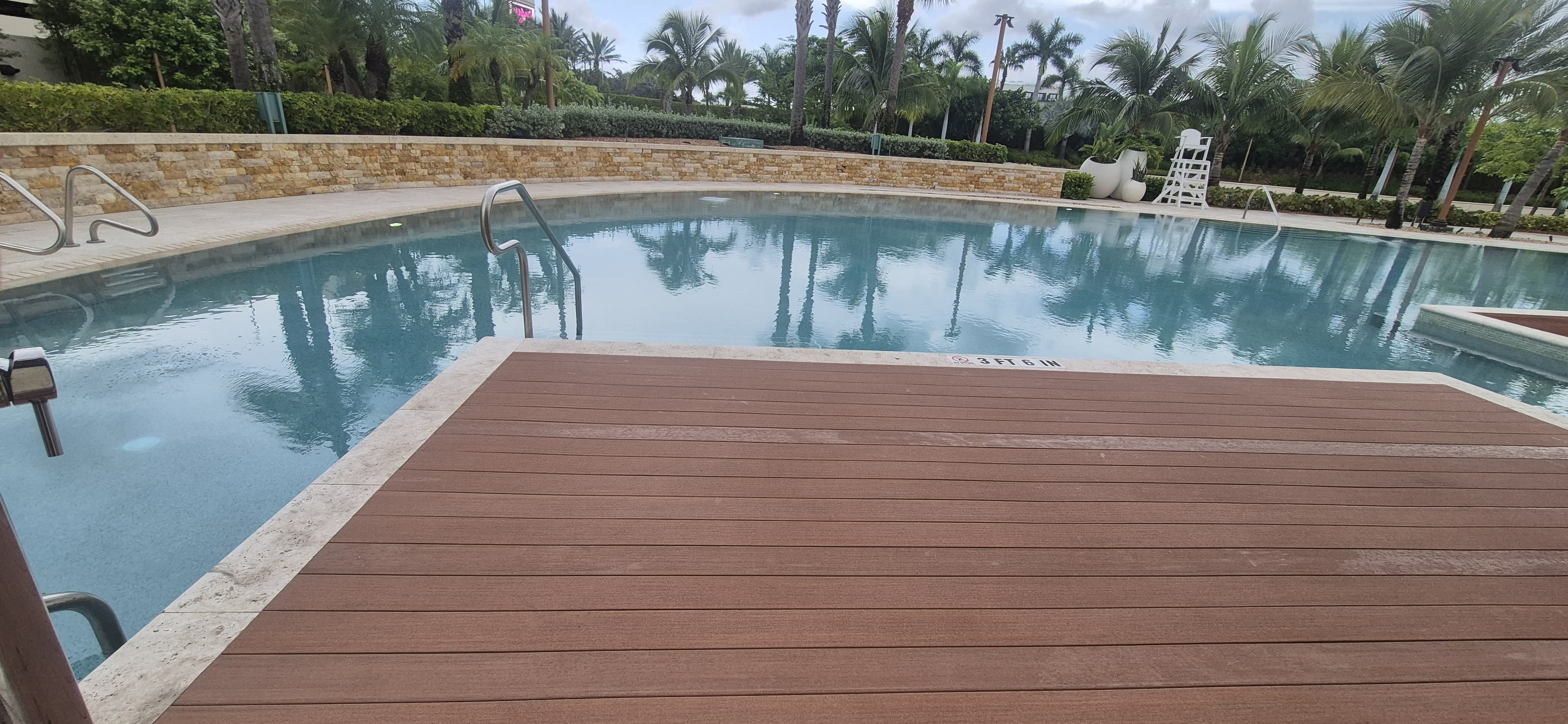
Hard Rock Guitar Hotel — pool deck
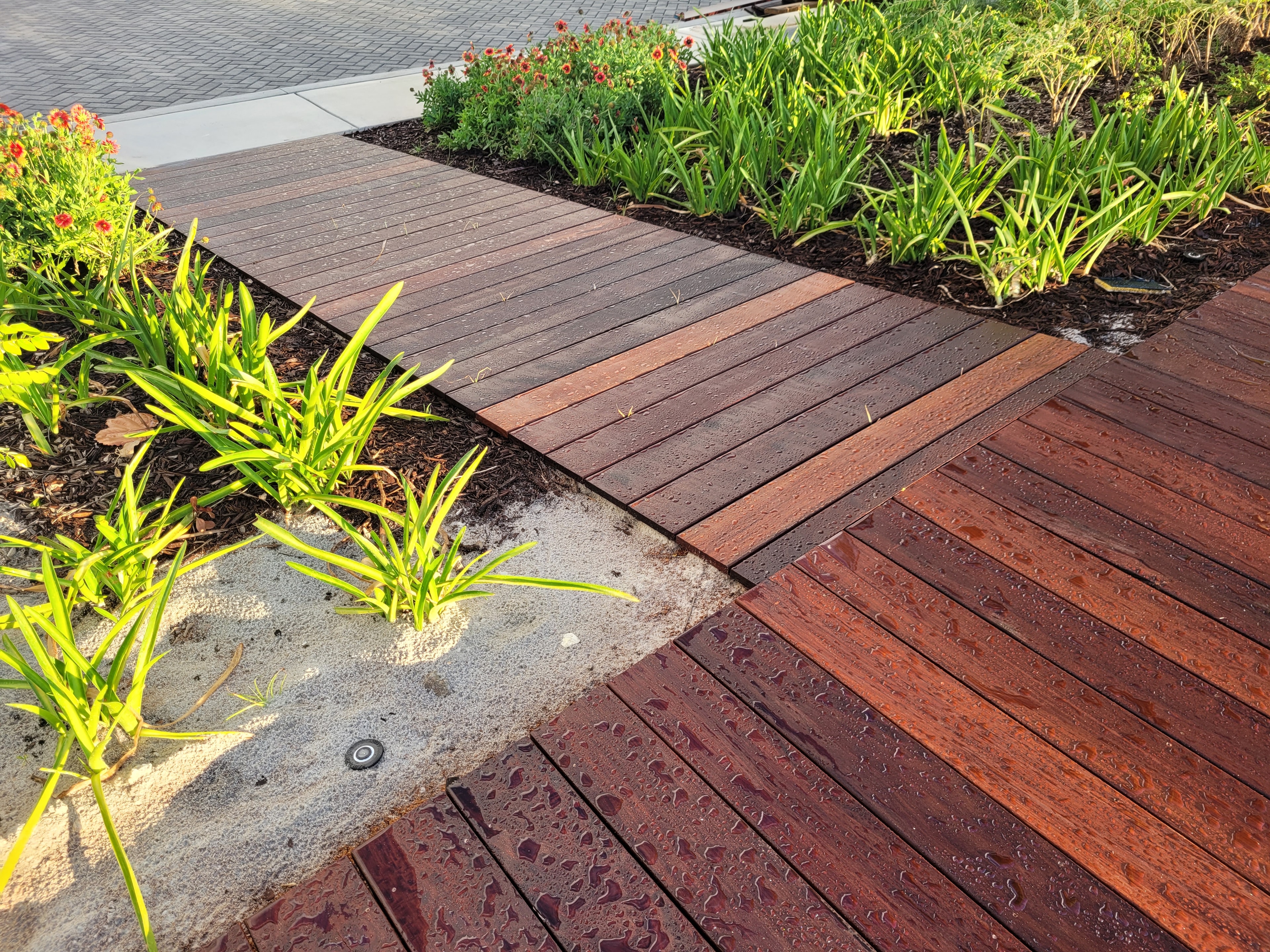
Ritz-Carlton Residences — waterfront deck
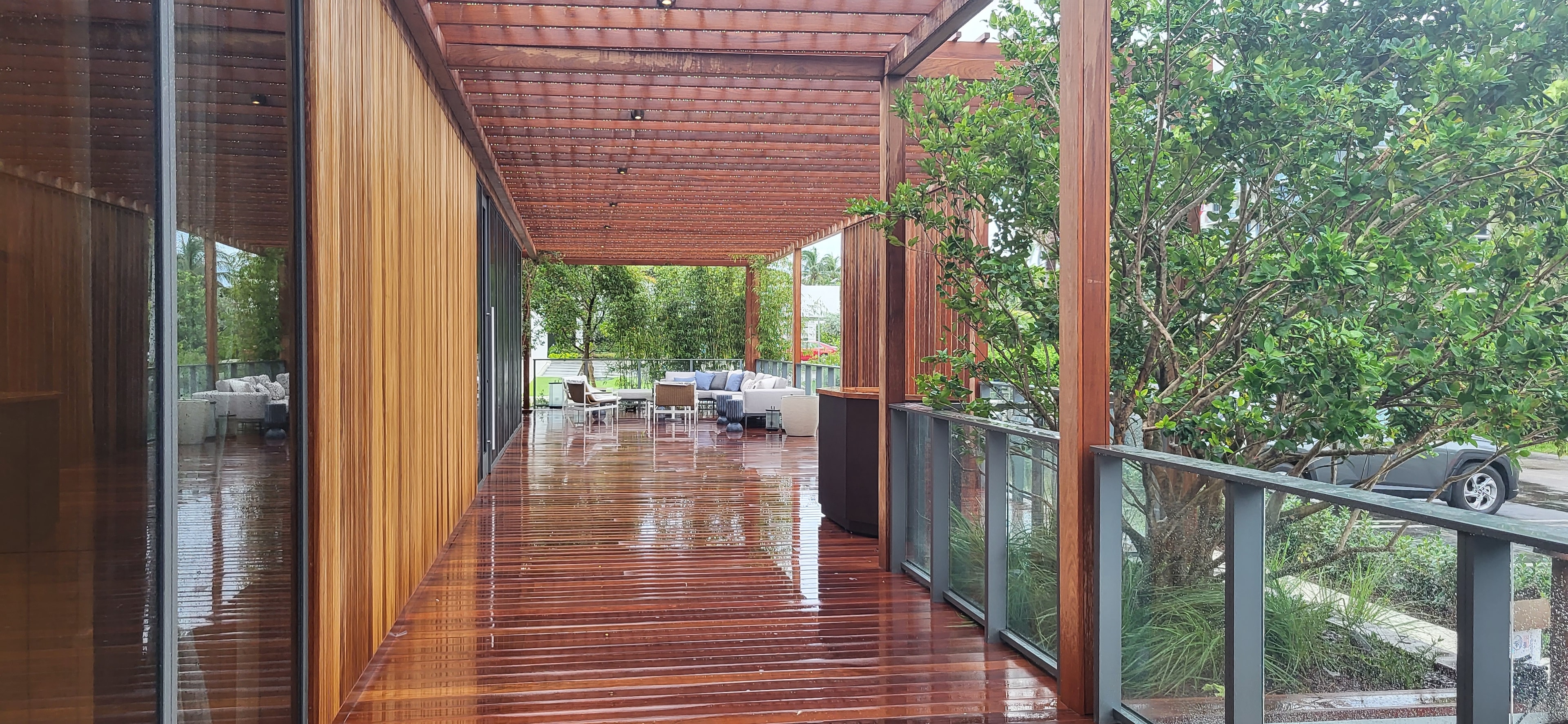
Waldorf Astoria Pompano Beach
The Cost of Doing It Twice
Sometimes the most expensive deck is the one that initially costs the least.
When a deck is built with inappropriate materials, inadequate framing, improper fasteners, or incorrect installation methods, problems may not appear immediately. They can show up months or years later as loose boards, excessive movement, corrosion, water damage, deteriorating framing, or premature material failure. In South Florida, where decks face intense sun, heavy rain, humidity, and coastal salt exposure, these decisions become particularly important. Correcting those problems can involve much more than replacing a few deck boards. In some cases, finished decking must be removed to access the structure underneath — meaning labor, materials, demolition, and installation are paid for a second time.
What goes into the true cost of a deck
What you pay to build the deck.
The product tier, framing system, fasteners, and installation methods specified.
Cleaning, sealing, hardware inspection, and other upkeep the material requires over time.
Addressing problems that arise from inadequate materials, improper installation, or environmental exposure.
How the structure performs and holds its value over 10, 15, or 20 years.
The goal shouldn't be to build the cheapest deck today. It should be to build the right deck the first time.
A properly constructed deck still requires maintenance, and no contractor can guarantee that problems will never occur. But appropriate materials, sound structural design, experienced installation, and manufacturer-compliant construction can reduce avoidable problems.
Ready to compare estimates?
Use the interactive checklist below to compare any two contractors side by side.
Go to the comparison checklistComparison Checklist
13 Things to Compare Before Choosing a Deck Contractor.
Use this checklist to compare any two estimates side by side. Fill in what each contractor has told you — in writing, not verbally.
License type, number, and current status verified through Florida DBPR.
Certificate of insurance for general liability and workers' compensation, current and confirmed.
Manufacturer name, product line, color, and board profile — not just 'composite' or 'PVC'.
Grooved or solid, thickness in inches, and whether it meets manufacturer span requirements.
Pressure-treated, steel, or composite framing; joist spacing at 12", 16", or other.
Hidden fasteners vs. face screws; stainless steel, hot-dipped galvanized, or standard.
Who provides engineering drawings, if required, and who pays for them.
Whether permits are included, who pulls them, and who coordinates inspections.
Whether removal of the existing structure is included and who handles disposal.
Duration, what is covered, and how claims are handled — in writing, not verbal.
Documented examples of similar projects in scope, material, and site conditions.
A written scope of work specifying exactly what is and is not part of the contract.
What maintenance will the proposed materials require? Are the framing, fasteners, and installation methods appropriate for the environment? What are the likely long-term ownership costs?
Print this checklist using your browser's print function (File → Print, or Ctrl/Cmd + P).
We're Not Competing to Be the Cheapest. We're Competing to Build It Right.
At Deckmasters of South Florida, we've spent 27 years working with different decking materials, framing systems, fastening methods, and challenging construction conditions. We know that the decisions made before the first board is installed can affect how a project performs for years. Our customers deserve to know exactly what they're paying for, why certain materials and installation methods are specified, and what is included in their investment. We're happy to explain those differences.
Want a concrete example of how scope differences explain a $20,000 gap? See the side-by-side breakdown.
Ready to talk through your project?
We'll give you a written scope, not just a number.
When you request an estimate from Deckmasters, you'll receive a written proposal that specifies the materials, framing, fasteners, and scope of work — so you can compare it accurately against any other estimate you've received.